

Accounting for the Acronyms: Showing Up with SEO, AEO, and GEO
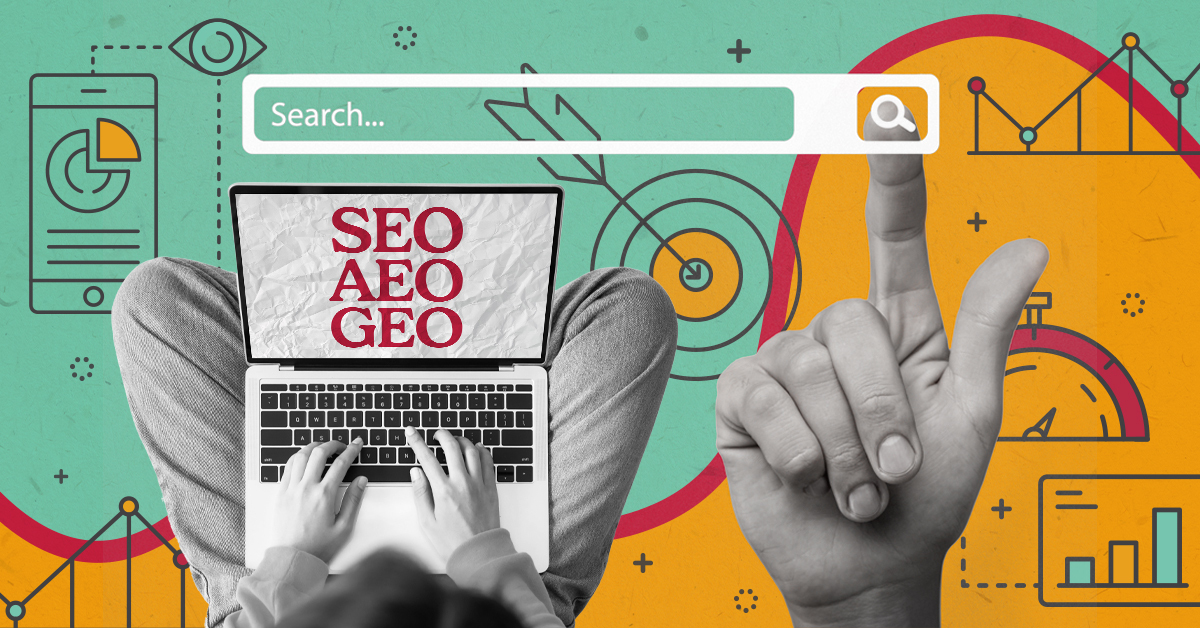
The world wide web. WWW. The internet started with acronyms, and they haven’t gone anywhere. Three acronyms now rule the conversation about search and website development: SEO, AEO, and GEO.
See a breakdown of each below along with tactics to boost your brand’s presence by accounting for the acronyms.
What is Search Engine Optimization?
SEO. The OG. OK, we’re going overboard on acronyms. But SEO has been around since basically the dawn of the internet. As soon as people started searching online, search engines (Google, Yahoo, Bing, etc.) supplied page results that best aligned with people’s queries.
SEO is all about ranking for specific keywords on those search engine result pages (SERPs).
How About Answer Engine Optimization?
AEO. This form arose with the advent of voice search and is focused on a single definitive answer to a specific question. The speech-based nature of AEO opened the door to more conversational web copy.
And Now Generative Engine Optimization?
Yes, GEO. This is the evolution of AEO. Using AI, generative engines like ChatGPT and Gemini pull from multiple online sources to provide summaries. Think about Google’s AI Overview that appears at the top of the page after you search. That’s GEO.
What’s the Goal with SEO, AEO, and GEO?
With search engine optimization, the goal is to rank higher on SERPs.
Think of SEO as a pyramid:
- The base is technical, as in your site being structurally sound and safe.
- The heart of the pyramid is on-page SEO, including keyword-focused headlines, body copy, and formatting to help with scannability.
- The top of the pyramid is off-page SEO, including backlinking, business listings, and social media.
With AEO, the goal is to provide the most-relevant answer to an asked question. AEO ushered in an era of “zero click search” and created a bridge to generative engine optimization.
With GEO, the goal is to be one of the sources used, mentioned, and cited in summaries. Discovering whether you’re appearing for pertinent questions currently means doing some manual work, like compiling your own list of relevant questions and searching to see how and if you show up.
What’s the Impact of GEO?
60% of searches now end up in zero clicks. That means people are finding whatever they need on Google or ChatGPT and not clicking through to another website. That percentage is even higher on mobile, resulting in an overall decrease in website traffic.
But when optimized for this new terrain, you can actually increase your visibility and web traffic. Our clients’ sites saw an 1800% increase in year-over-year visits originating from AI platforms like ChatGPT.
Strategies to Help with SEO and GEO
The good news is that SEO and AEO/GEO strategies often overlap. Accounting for one will typically help the other, with a few nuances.
Site security and performance are as important as ever. Ensure your site is safe and fast for users and structure content that is scannable and easily indexable.
We All Have to EEAT
Get to know another acronym: EEAT. Standing for experience, expertise, authority, and trust, EEAT is a framework to show up higher and more often in SEO, AEO, and GEO results. Draft your content to account for each aspect and increase your visibility. We’ve covered this before.
Where to Start: SEO or GEO?
Think citeability versus clickability. You can achieve both.
If you haven’t done much or any previous search optimization on your site, start there. Prioritize keywords and structure that will help you rank higher. Don’t stuff, but do incorporate top keywords into headers and naturally within body text to bolster your standing.
If you already have a strong SEO base on your site, start auditing and refining that content for GEO. That will likely involve reformatting information, updating copy to be more conversational, and adding short content summaries to each page to help with information sourcing.
Also, consider the question-and-answer format of GEO and build out sections on popular pages that fit that format. For instance, short FAQ sections (3-4 questions and answers max on each page) that address the most common questions in your industry related to that page.
Bonus tip: Look at how search engines and generative platforms are presenting information, then mirror your content based on that structure.
Your Work Goes Beyond Your Website
Think about where you and your information live. Reddit is becoming an increasingly popular source for GEO responses, so it’s wise to think about how your business can establish a presence on that platform. It won’t be through shameless promotion; Reddit users see right through that. But if you show up with thoughtful responses to questions in subreddits, your brand builds both awareness and credibility. Think of it as the evolution of content marketing.
The more you appear on other sites and platforms, the better your GEO. Take this opportunity to gut check your own credibility, status, and profile. If a blog came out tomorrow featuring the best companies in your industry, would you make the list? If not, what would it take for you to get there? Because those sorts of articles are powerful kingmakers when it comes to GEO authority. That’s why it’s important to build out your digital marketing, heighten your public relations, spread your social media presence, and establish partnerships within your industry. Mentions matter. Your website is just the start.
